
Systems Architecture Approach
The deployment was designed around four avionics-inspired principles:
Signal Integrity - Every lifecycle event is treated as a validated signal. Status transitions are structured, timestamped, and synchronized across stakeholders. There is no unstructured state propagation.
Deterministic State Transitions - Asset movements progress through defined operational states, comparable to controlled flight phase transitions. Each state carries predefined accountability, documentation, and financial mapping.
Closed-Loop Traceability - Every operational event links to compliance artifacts and financial entries, creating an auditable feedback loop similar to maintenance logbook continuity in certified environments.
Layered Visibility - Engineering, operations control, partner teams, and leadership access role-aware telemetry. Data is contextualized, not broadcasted.
Operational Telemetry Evolution
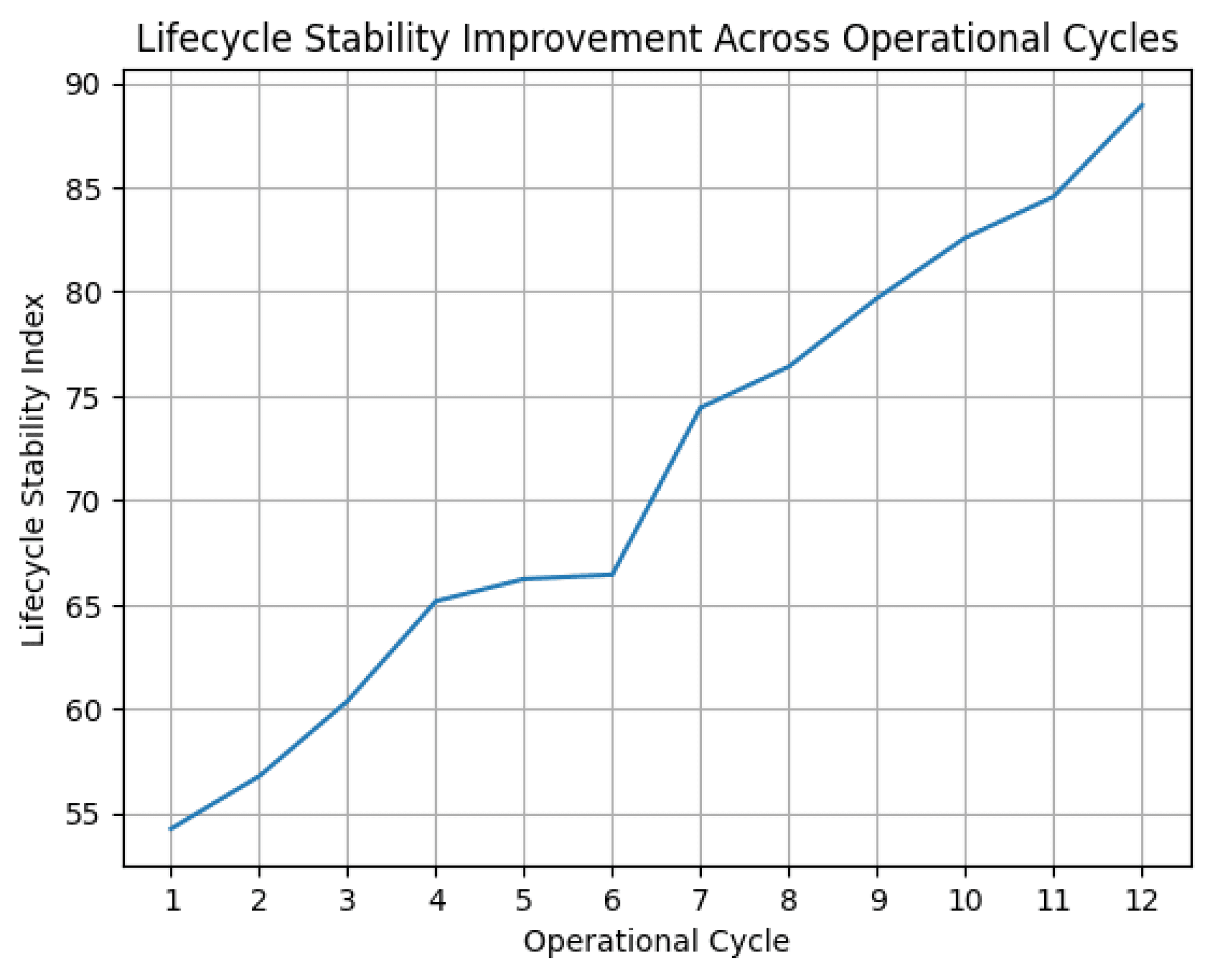
Lifecycle Stability Trend
Visualized as a reduction in state volatility across repair phases. The curve demonstrates increasing predictability over successive operational cycles.
Coordination Latency Compression
Trend lines indicate narrowing intervals between status transitions and delivery confirmations, reflecting improved synchronization between airline and partner teams.
Financial Exposure Alignment
A converging band between operational activity and reconciliation workflows illustrates tighter coupling between engineering execution and financial reporting.
Compliance Signal Density
Documentation capture frequency aligns directly with lifecycle events, eliminating post-cycle aggregation and retroactive assembly.
These trends reflect structural improvement rather than isolated task acceleration.
Engineering Control Implications
The system enables:
Distributed Asset Telemetry Consolidation
Repair load concentration and station-level exposure are visible within a unified operational grid.
State-Driven Partner Interfaces
Partner actions are governed by structured checkpoints embedded in the lifecycle model, reducing ambiguity in execution sequencing.
Exposure Mapping
Each asset’s operational state is directly mapped to financial and compliance attributes, forming a synchronized cost-awareness layer.
Audit-Ready Event Ledger
Every transition generates an immutable, timestamped record suitable for internal governance and regulatory review frameworks.
Organizational Impact
For Air India Express, the shift was architectural.
Leadership operates with near real-time awareness of distributed asset posture.
Engineering functions within deterministic state flows.
Partner interfaces operate under defined digital checkpoints.
Finance observes synchronized operational exposure rather than deferred reconciliation.
The operational environment now mirrors avionics logic:
Integrated.
State aware.
Redundant in documentation.
Predictable in execution.
Industry Signal
As fleets expand and station networks become more distributed, aviation organizations require operational architectures that resemble the rigor of flight systems rather than ad hoc coordination layers.
The Air India Express and Vertex Aviation deployment demonstrates that avionics principles such as state determinism, telemetry integrity, and closed loop traceability can be extended beyond the aircraft into ground asset governance.
The result is not incremental optimization. It is systemic stability