
Why most simulation tools fall short
Three things break in how operational simulation works today.
Simulations are manual. A planner picks a scenario, runs it, reads the output, picks the next one. The space of "what could happen" is vast. The space of "what actually got modelled this week" is whatever three or four scenarios someone had time to run.
Cascades get simplified away. Change one parameter and the effects propagate across inventory, capacity, cost, coverage, and timing. Modelling all of it takes a week. So teams model the first-order effect and accept the rest as risk.
Outputs are scenarios, not actions. Planning tools return numbers in cells. Translating that into "what do we do, in what order, at what cost" is a separate exercise usually in someone's head.
The result: teams operate on the scenarios they had time to run, miss the ones they didn't, and find out about cascading consequences after they've already happened.
What Sentinel does differently
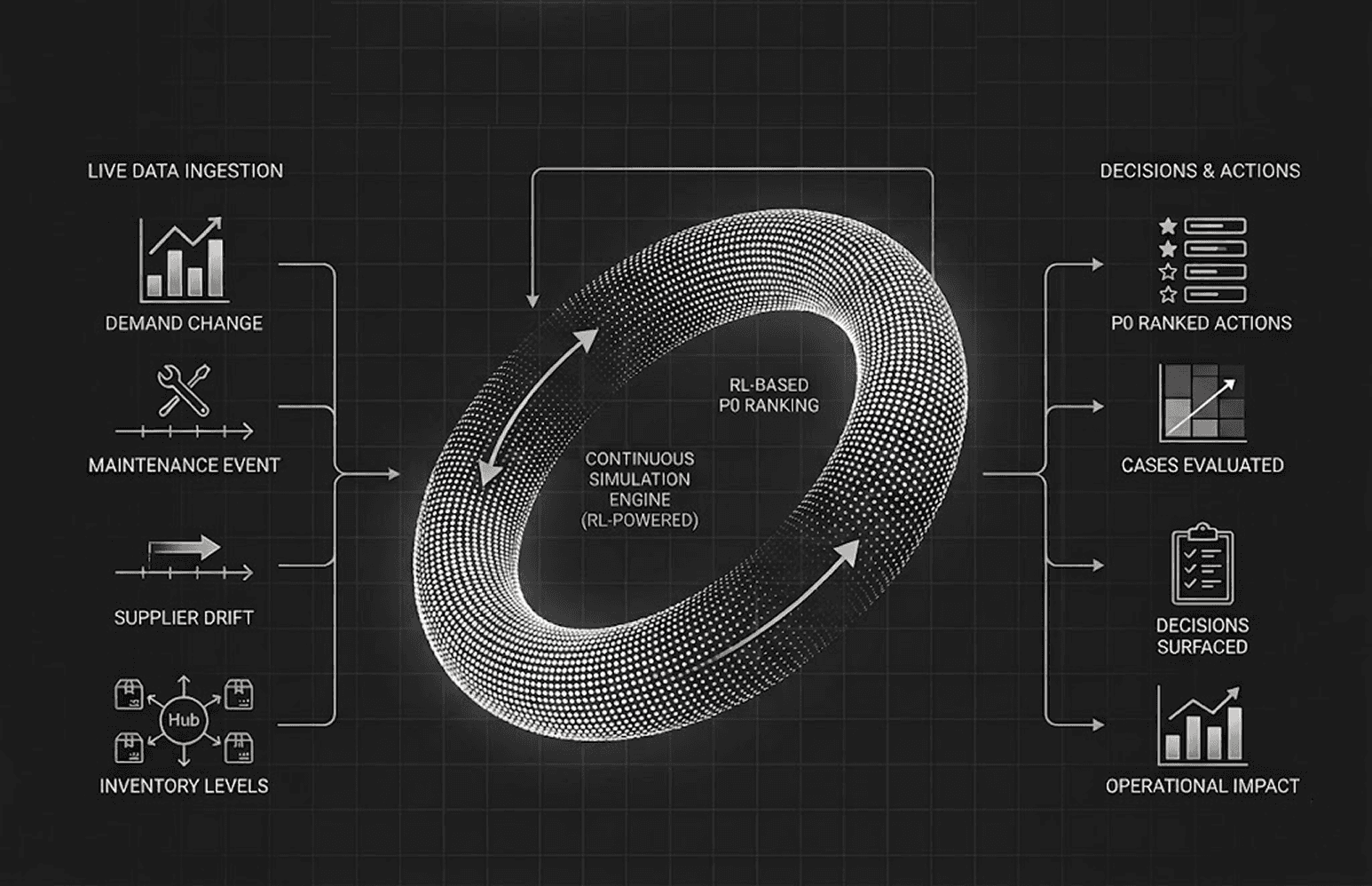
Sentinel runs continuously. Every minute, it sweeps the dependency graph of your operation programmes, parts, hubs, suppliers, fleet assets, schedules — and simulates the cascade of every change as it arrives.
When it finds a decision worth surfacing, it ranks it. Cost impact, risk impact, coverage impact already calculated. Sequencing already mapped. The operator approves. The system executes.
The shift: your team stops asking Sentinel questions. Sentinel surfaces the questions worth asking.
Supply chain: the demand change that triggers a week of work
A customer adjusts a programme from 10 units to 12. In a traditional setup, this is five days of meetings, BOM pulls, hub stock checks, supplier calls, and financial modelling.
Sentinel cascades the change in one pass: BOM expansion across every part, stock position across every hub, supplier capacity against the new pull-through, transfer cost against logistics and lead time, financial exposure if no action is taken. Output: a ranked list of actions ready to approve.
Fleet: the unplanned event you didn't catch in time
A maintenance event takes an asset offline mid-cycle. Sentinel cascades the impact across availability, mission readiness, redeployment options, intervention cost, and timing. Output: move this asset, accelerate this maintenance window, defer this lower-priority mission.
The P0 you didn't know to look for
This is the real shift. While your team works on the obvious, Sentinel runs in parallel — surfacing things like:
A supplier whose lead time has drifted 8 days across the last quarter, putting a programme at risk no one has flagged yet
An export-control compliance gap on three parts that becomes blocking in 14 days
An inventory imbalance across hubs costing rent on excess at one location while creating shortfall risk at another
A demand pattern shift that makes a current safety stock policy 30% over-buffered
You didn't ask. Sentinel saw it.
How it works
Dependencies as a graph. Sentinel models programmes, parts, hubs, suppliers, and assets as a connected graph. When anything changes, it knows what touches it and how far the change propagates.
Parallel simulation. Instead of running scenarios one at a time, Sentinel sweeps dozens of variations across demand, capacity, lead time, and cost simultaneously. The underlying logic comes from reinforcement learning — scoring sequences of actions across a horizon, not single points in isolation.
Ranked actions, not scenarios. Outputs are decisions ready to execute, with cost, risk, and coverage impact pre-computed. Operators approve; they don't translate.
Continuous operation. Sentinel doesn't wait to be asked. It runs against your live data 24/7 and surfaces P0 actions as they emerge.